Feeds:
Posts
Comments

Posts Tagged ‘Kids’

I have recently started leading regularly at our Junior Church. When I began, we were using materials which were tailored to a narrow age range and which were tied to the lectionary and sometimes seemed to miss the point of the passage.

Since our group has an age range of 3-14 and we don’t follow the lectionary in church, we have now switched to using On The Way for 3-9s. Although this still misses the top age range we have, it caters for a greater number of the children, and also enables us to design our own programme of teaching.

On The Way has excellent craft resources and helps you to get into the passage you’re teaching yourself. It doesn’t, however, always help you to prepare the teaching of the passage very easily. At the moment we are doing a little series on some of the kings of Judah, which has been great for me as some of the passages were unfamiliar to me, let alone to the kids!

So to help me to tell the stories of some of the passages (and to source some good colouring pages for less well-known stories) I now turn to Deaf Missions – their daily reading notes are available online and give some excellent short summaries of bible passages together with clear black and white illustrations which blow up very well for colouring in. Check out their page on Jehoshaphat and Ahab to see what I mean.

I always like to have a colouring page and a wordsearch for the children – sometimes I like to get them to colour in a picture as I explain the bible passage, as it can help with concentration. And it’s always useful to have something up your sleeve in case the Vicar preaches too long and you’re in Junior Church for an unplanned extra ten minutes.

DLTK have a good selection of colouring pages. For wordsearches I tend to go to Calvary Church‘s site first – they also have colouring pages on many passages and other word puzzles, although the bible version they use (possibly the American Standard?) doesn’t usually mesh with the readings we use, so I don’t use the more complex puzzles. If the passage isn’t in the Calvary Church curriculum, I go to Teachers Direct, where you can make your own wordsearches – cool, eh? Unsurprisingly I used this when teaching about Jehoshaphat.

Do you have any favourite online places for Sunday School resources? Do share!

Read Full Post »

All age services are a great way for families to worship together, but it can be a real challenge to keep them fresh and accessible. This weekend we began a new series for our monthly All Age gatherings. We are going through Colin Buchanan’s great song ‘Big Words that end in SHUN’, from his Super Saviour album, teaching a big word each month:

Big words that end in SHUN!
Show us what the Lord has DONE!
Through Jesus, His own SON!
Big words, Big words that end in SHUN!

Revela-­‐SHUN!
God shows himself to us
Substitut-­‐SHUN!
Jesus takes our place
Salva-­‐SHUN!
Sinners saved from hell
Big words, Big words that end in SHUN

Propitia-­‐SHUN!
God’s anger turned away
Justifica-­‐SHUN!
Just like we’d never sinned
Imputa-­‐SHUN!
Jesus’ righteousness is mine
Big words, Big words that end in SHUN

Resurrec-­‐SHUN!
Raised from death to life
Redemp-­‐SHUN!
Sinners bought by God
Adop-­‐SHUN
Sinners made God’s sons
Big words, Big words that end in SHUN

This Sunday we tackled REVELA-SHUN and the Vicar spoke on Hebrews 1:

In the past God spoke to our ancestors through the prophets at many times and in various ways, but in these last days he has spoken to us by his Son, but in these last days he has spoken to us by his Son…

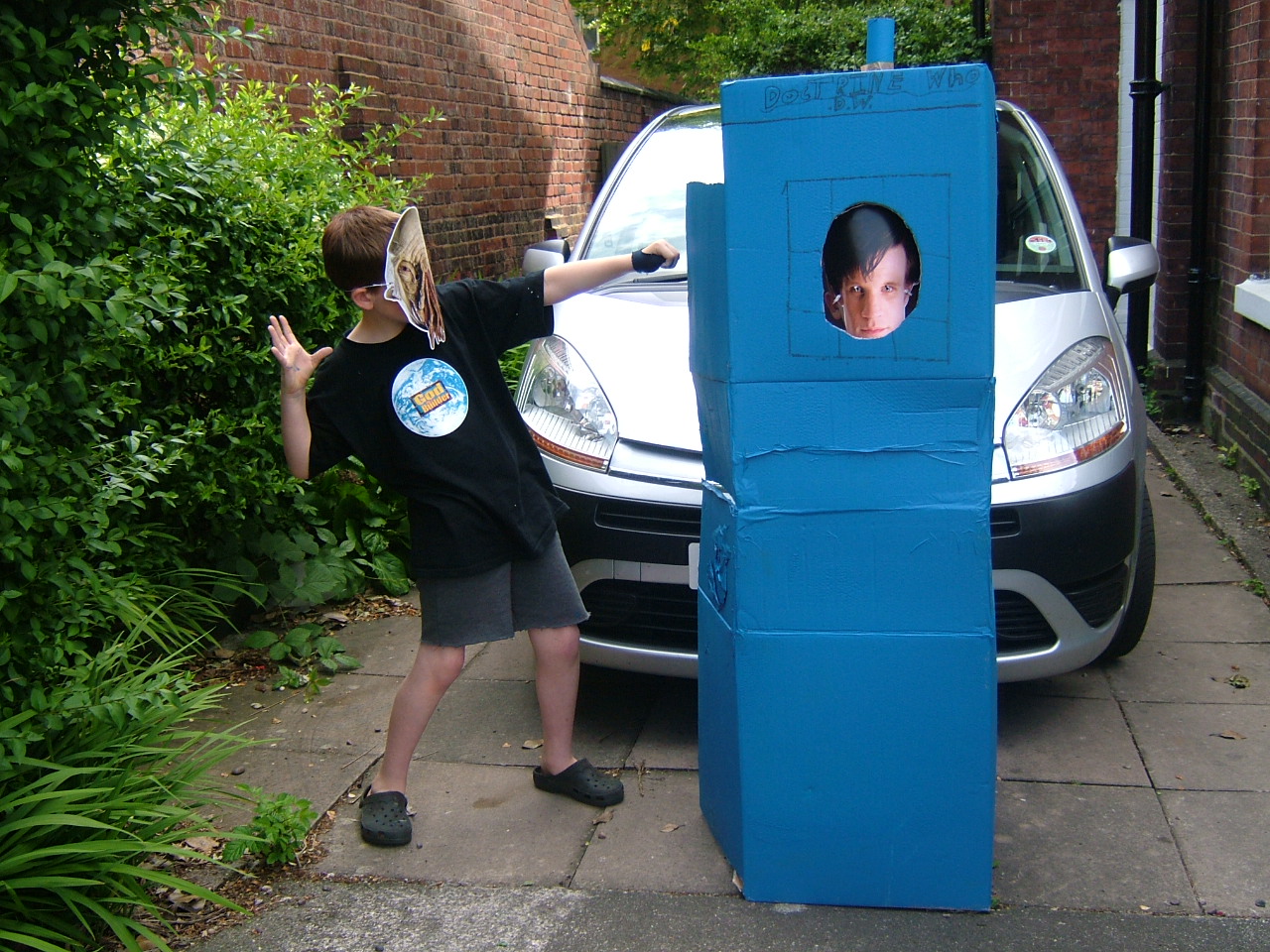
So the Vicar decided that we could get Dr Who to come and take us back to meet a few of the prophets to find out what they had to say. Suddenly plans were afoot for the construction of a tardis and the Queen, the Joker and the Engineer were very pleased to spend a day in half term wielding paintbrushes.

Tardis construction in the back yard of the Vicarage

Once it was painted, the Joker decided that our tardis should be manned by Doctrine Who. And so here is the finished item in our front drive, being shown off by Doctrine Who and an enemy (although my knowledge of Dr Who isn’t sufficient to tell you which enemy it is). It went down very well on Sunday morning, and is now installed in the boys’ bedroom, where time-travelling adventures continue.

Doctrine confounds an alien

Read Full Post »

Last week my two younger kids were in bed, but they were having trouble getting to sleep. That was mainly because some of their classmates were still playing loudly in the street below our house. The youngest of the kids still playing out was eight. And it was 8.30pm, so I thought it probably appropriate that they go home and possibly even consider going to bed themselves.

When I proposed this to them, they were incredulous. They didn’t want to go to sleep yet. So I suggested that perhaps they could get into their pajamas and read a book before bedtime. The eight year old then emphatically told me:

Books are for BABIES!

A report from the National Literacy Trust has been in the news this week, talking about how book ownership is linked to educational attainment. We have lots of work to do here if the children of our parish are going to reach their potential. And be able to read their bibles so that they can know the living Word.

Read Full Post »

Last week I blogged about some poetry books that I like to read with my own kids, and with the schoolchildren that I spend time reading with each week. The other resource that I use every week at school and that my gang at home have loved are a series of short stories, two in each book which come in a series as ‘A Pair of Jacks’.

There are four books in the series, written by Michael Lawrence and illustrated by Tony Ross. Each story is about 60 pages long, with large print and good pictures. What makes them great for readers all through Key Stage 2 (the Juniors to those of us who went to school before the National Curriculum) is that although there are not many words, there is much rich vocabulary and lots of fun with literary form in just a few pages.

Fiction-averse boys have enjoyed these stories as much as the girls – they are clever and humourous. They often play around with classic stories – the first one in the book shown above is called ‘Jack and the Broomstick‘ and is a parody of Jack and the Beanstalk – great for more able kids to think about how the original story has been subverted, but simple enough for the less able to enjoy aswell. This week I was reading from Jack-in-the-Box with a few of the children and we were discussing the meaning of ‘console’, ‘magnanimous’ and ‘ingrate’ as well as the frequency of orphan stories in children’s literature.

I’m planning a bit of a Jack-fest this half term with my kids – I’m going to see how receptive they are to guided reading with Mummy. Wish me luck – it’ll not be the books that are the problem if it goes wrong…

Read Full Post »

If you follow me on Twitter, you might have picked up that I help out at our church primary school most weeks, reading with kids who need a bit of a boost with their comprehension and language.

What’s been fun for me this year has been spending time with kids with a wide range of abilities – some are on a level 2 (just about reading) and others on a level 5 (top ability at the end of school). All the kids are in year 5 or 6 and they come to me in pairs and only have about half an hour.

Since there is so little time, I’m not able to listen to them read at length or discuss a long text, especially as I like to play comprehension board games (not very cheap but lots of fun) with them too. So over the time I’ve been meeting the children, I have gradually discovered some reading materials that are enjoyable to read but also short! And these are now coming in handy at home when bedtime is getting a bit late and the kids are still pleading for a story.

The best way to have a speedy story is to read poetry. For these year 5s and 6s I’ve been using Anne Fine’s anthologies called ‘A Shame to Miss’. Parts 1 and 2 are suitable for primary aged children and contain wonderful poems and occasional notes from Anne Fine, explaining context or difficult vocabulary. I’ve found these books really helpful for improving vocabulary and helping comprehension at school, and at home the kids enjoy the rhythm and richness of the verse. There’s enough variety to suit all abilities, but these are particularly good for the higher end readers.

My kids adore poems, especially funny ones and since they’ve been young we’ve had two books of poetry which we return to again and again. The first is The Puffin Book of Fantastic First Poems, a colourfully illustrated anthology edited by June Crebin, which is now minus its front cover and torn about the edges because it’s been so well used. The second is Mustard, Custard, Grumblebelly and Gravy by Michael Rosen. This book is hilarious, full of quirky poems about everyday situations, and has caused my children to commit poetry to memory. The first year we had the book, they wanted to spend all summer repeating ‘Tiffy taffy toffee on the flee flow floor’. They learnt it by heart and we were blessed with its silly rhymes for months.

Read Full Post »

The other day I noticed an interesting tweet in my Twitter stream:

Just finishing talk for tomorrow’s Easter Praise. Have taken @thevicarswife Resurrection Eggs & adapted them for under 3s. It will be mayhem

So I got onto Abi, who was responsible for the tweet and asked her if she’d mind writing up the details of her session – I thought it might be a useful resource for all toddler group/Sunday school teachers out there.  She very kindly sent me a write up and a photo of her eggs. And there’s even still time before to use her ideas this Easter. Maybe even if you’re a Vicar struggling for an All Age Easter Sunday talk aswell. So, over to guest blogger, Abi:

Our Parent & Toddler group is a thriving ministry and the leaders are great at taking opportunities each week to share the gospel. Two notable opportunities that are taken are at Christmas and Easter. A short ‘Toddler Praise’ service takes place as part of the normal session in the church. This year I was asked to do the short talk. My natural comfort-zone is Pathfinders (11-14 year olds), but I agreed nonetheless!

I remembered reading about Resurrection Eggs last year, and so took the idea and adapted it for pre-schoolers. I reduced the number of eggs involved down to 6. I also used much larger eggs. My local Hobbycraft had some ‘paint your own’ cardboard eggs, about the size of an average chocolate Easter egg. I painted them in bright colours and numbered them 1-6. The numbering was crucial, if only so that I opened them in the right order! The colours were just for the children. I scattered the eggs about for the children to find at the appropriate time(which they were very eager to do). Although the way I told the story was aimed at getting and keeping the children’s attention, I was aware that parents would be listening, so some of the language is maybe a bit adult for the younger toddlers.

I explained to the children that I was to tell them a true story; that it was all about the first ever Easter and was all about Jesus. I said there were some sad parts, but there were also happy parts. I explained that to help us learn this true story, there are some eggs hidden around the place that have bits of the story inside. At this point some children ran to get the eggs, whilst others sat still pointing to where they were…!
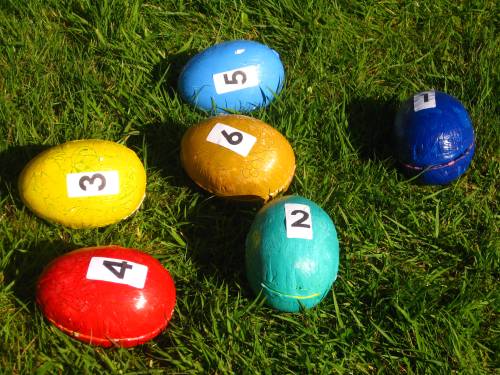
We opened the eggs in number order to see what was in each egg, with me saying something along the following lines:

  1. Donkey – Jesus was going to a town called Jerusalem with his friends. He rode into Jerusalem on a donkey. Some people were very happy to see him, and they welcomed him, shouting ‘Hosanna’ and ‘Jesus is King’. But some of the leaders weren’t very happy to see Jesus. They didn’t like that the people liked Jesus.
  2. Praying hands (just a picture found via google) – Later that week, Jesus went with his friends to pray in a garden. Jesus prayed to his Father God that he was doing the right thing. But while he prayed, soldiers, sent by the leaders came and arrested Jesus.
  3. Cross – The soldiers took Jesus away and made fun of him, and put a heavy wooden cross on his back. He was made to carry it up to a nearby hill. Some people cheered, but some people knew this was very sad, and cried.
  4. Nails – On the top of the hill, Jesus was nailed to the cross. It hurt him a lot. Jesus had never done anything wrong, like we have, but he was treated like he was a criminal by the soldiers. Even though this was the middle of the day, on a Friday, it became really, really dark. In the dark and with the sadness of his friends and family, Jesus died.
  5. Stone – Some of Jesus’ friends gently carried Jesus to a tomb, cut in the rock. A bit like a small cave. A huge stone was put over the tomb so no-one could get in or out. Jesus’ friend were sad, and thought they would never see him again. Three days later, on the Sunday, a woman called Mary Magdalene went to the tomb. She was amazed to see that the huge stone wasn’t blocking the way in, and like our sixth egg, the tomb was:
  6. Empty! – Jesus had risen from the dead. It was such happy news. Our true story has a happy ending.

I went on to explain how it can be a happy ending for us today, because Jesus died and rose from the dead so we could be saved.

I also said: “When we say or do things that are wrong, we must say sorry, don’t we?, to our parents or friends or brothers or sisters. We need to say sorry to God too. We ignore him, we say wrong things, we do naughty things. The Bible calls this sin.

Because of Jesus, who has never done anything wrong, or said anything naughty, and has never ignored God, we can be friends with God. We can be saved. Jesus’ death and rising again means we won’t be enemies with God, if we trust in Jesus and ask God for his forgiveness. We will be safe and we will be forgiven.

Let’s pray.
Dear God, thank you that you sent your Son Jesus to die and rise again, so that by trusting in Jesus and asking for forgiveness we can be friends with God, we can be forgiven and we can be saved. Amen”

Things to note:

>- Make sure an adult is nearby to give the nails to when that egg is opened! With the other items, the Toddlers often picked them up to wander off to show their parent or grandparent.

– We sang a song part-way through to break it up. We also sang one at the start and one at the end. All 3 had actions, and 2 were ones they knew from being incorporated in the usual weekly singing time (a mixture of Christian and other songs/choruses)

– This could be adapted and expanded for an all-age service with Bible readings included in the contents of the eggs to make it helpful to a wider age-range, along with other parts to the service as well of course!

Read Full Post »

Last year I made a set of Resurrection eggs to talk the kids through the Easter story over 12 days leading up to Easter Sunday. Actually, last year, I started rather late, so it went on post-Easter too.

After Easter I discovered that they sell empty plastic eggs in The Works – those shops seem to be nearly everywhere. Much easier than sending off to Baker Ross. So you could pop out this weekend and sort out a set. I was thinking that making a set would be a fun activity for the holidays. We’ll dig out our set from the cellar and maybe tweak the contents a bit.

Just to save you clicking through, here are the readings and fillings from the original post.

Day 1: Cottonwool ball soaked in perfume (not sure how authentic Elizabeth Arden Green Tea is as a fragrance)
Day 2: 5p pieces for the silver – thankfully I had some in my purse.
Day 3: Matthew 21:1-11. Donkey or palm leaf – Playmobil pot plant pieces.
Day 4: Matthew 26:26-29. Cup or bread – a Playmobil wine glass and a piece of bread.
Day 5: Luke 22:39-46, 54a. Praying hands or pipecleaner man – I stuck together some pink foam which I cut into the shape of praying hands. A little lurid in colour.
Day 6: John 19:1-7. Purple cloth. Well the cloth is maroon, but it was the best I could find.
Day 7: John 19:16-17. Cross. I made this by snipping off the bottom of one of the kids’ palm crosses and sticking it together. Shhhh – don’t tell them.
Day 8: John 19:18. Nails. Sourced from the Vicar’s tool cupboard.
Day 9: John 19:33-35. Toothpick (for the spear). Actually I used  half a cocktail stick (no toothpicks in the Vicarage), covered in silver foil.
Day 10: Matthew 27: 57-60. Rock. Some gravel from the drive. Washed.
Day 11: Mark 16:1-3. Cinnamon/cloves/spices. Had plenty of these in the cupboard.
Day 12: John 20:1-8. And nothing in the egg! This was easy.

If you’re really keen, Meredith commented last year with fifteen readings from Mark or even a series of 21 readings which you could use instead. And a Twitter friend mentioned that she’s adapted the idea for her Sunday school class. I’m hoping to extract some details from her later!

Read Full Post »

Another book from the pile I picked up from CLC to review for our Pathfinder venture is Afterwards I Knew, which contains eight short stories, mostly set in Holland during the Second World War. The stories are fictional but are movingly told, recollecting hardships and difficult choices made by Christians in times of hunger and oppression.

The stories are peppered with lyrical language, scripture and poetry. They tell of families reunited, people finding faith and standing up for Christ.  There is rich theology here too – God’s grace in difficult times and despite our weaknesses and assurance of God’s love and the hope of the resurrection when we feel the weight of our sin.

Christian Focus recommend ‘Afterwards I Knew’ for children over 13 years old and I think 11 year olds with good comprehension skills (and knowledge of the Second World War) would be fine with it. The only rider I would place on this book is to ensure that those reading it know it is fiction. The stories are so uplifting and moving, it would be tempting to believe that they actually happened.

Who for: Boys and girls ages 11 and up (and grown-ups)
Genre: Short stories, historical fiction
Recommended for Pathfinder camp: Yes (for older Pathfinders)

Read Full Post »

As I mentioned the other day, I have a large pile of books that I thought might be suitable for kids on our Pathfinder camp this summer. Being a diligent sort of bookstall person, I’m aiming to read them all. And today I whizzed through the first one, Deadly Emily by Kathy Lee.

Emily Smith is a Christian. She’s still at primary school (I’m guessing Year 5 or 6) and her parents have split up so she, her brother and her mum have moved to live with her gran. Moving to a new place, coping with a new school, dealing with bullies and trusting God when everything seems to be going wrong are all covered.

Kathy Lee’s story is well written with an exciting plot which would especially appeal to girls who enjoy school and adventure stories. I liked the way in which Emily’s Christian faith is portrayed realistically without becoming cheesy. Emily clings onto God’s word in tough times but doesn’t always choose the godly thing to do. She’s a normal Christian girl and I think this makes her very accessible for the readers I’m aiming at. It’s not too long (138 pages), has no illustrations and would not be too intimidating for competent primary school readers or younger secondary school pupils.

Who for: 8-13 year old girls
Genre: School/adventure
Recommended for Pathfinder camp: Yes

Read Full Post »

Not my own, you understand. I am definitely morning-challenged and I have a battle with myself every day as I force myself to leave the cosiness of bed. But we have recently discovered the wonders of children with alarm clocks.
Some folk complain about how their kids are always up at 5am or some other hour before God has risen. But ours have always been blessed with a good sleeping-in instinct. This was great when they were tiny, but now that they need to be up for school it has begun to be somewhat problematic. The Queen, if left to her devices, will sleep until 9am. Not good when school starts at 8.45am and there are things like getting dressed and breakfast to be dealt with.

So we have been waking our children in the mornings and cranking them up for the school day. It had got particularly bad with the Queen as she likes to feel in charge of as much of her life as possible and recently, she has felt very strongly that getting up should be her domain. This means that she does not take kindly to being woken up, given a morning cuddle, having her clothes presented to her, having her curtains opened or any other morning activity being done for her by others. As you can imagine, there have been a few stressful mornings, when Mum or Dad appearing and trying to help has had the opposite of the desired effect.

Then I had a very helpful conversation with Glamourpuss, who also has a strong willed daughter, who was also getting grumpy in the mornings. Glamourpuss told me how she gives Wildchild her phone, with its alarm set. Wildchild is in charge of waking up to the alarm and bringing her mum the phone every morning. So I went straight out and bought an alarm clock for the Queen. We’re now a week in and our mornings have been transformed. The boys have one too, which has been helping them to rise, but it’s the Queen’s attitude that has undergone the greatest transformation. She has been delightful in the mornings – up and dressed without any shouting needed, and this morning she also went and spent time reading her new devotional book, praying and looking at her bible. All before breakfast.

Now a week is obviously not a habit, but I’m so glad that one of the big battles in our house seems to have disappeared. And so simply. Now I just need to find out how she bounces out of bed immediately the alarm goes off and copy her…

Read Full Post »

« Newer Posts - Older Posts »