Something I’ve been thinking about a lot recently is complexity. The complexity of our society and economy has been made clear as the government has made decisions during the pandemic which have had unforeseen consequences. They’ve not had enough information about every single person and their situation as they’ve tried to make provision for people in lockdown. So there have been changed plans and new initiatives as things have become clearer. The individual histories and situations of each person in a nation is almost impossible to imagine and to grasp. A very interesting thread on Twitter from Robert Colvile, director of the Centre for Policy Studies, outlined how pandemic policies backed up by databases – information – have been far more successful than those without.
I’m not in government (thankfully!) but I am involved with some other complex and difficult situations. And I can see that decisions, or pronouncements about decisions, are often made without enough information, and certainly without all the information. It’s a blessing of aging, of experiencing difficulties and struggles as well as joy, that you gain a much bigger grasp of complexity. That you learn to see the politics, the relationships and the history behind things. I find that I often feel overwhelmed as I get a glimpse of complexity, especially where there are decisions to be made.
But that has also given me a bigger vision of the greatness of the LORD, who sees everything from the beginning to the end, who has all the information, in all its complexity. He is never overwhelmed, he grasps all the politics, the relationships and the history. Praise God for his understanding of all that he has made.
The Lord looks down from heaven; he sees all the children of man; from where he sits enthroned he looks out on all the inhabitants of the earth, he who fashions the hearts of them all and observes all their deeds.
On Saturday afternoons I head to the Secret Field with the Vicarage Hound. There we meet up with an enthusiastic retired greyhound for a run about. The Vicarage Hound is rather put out that the greyhound is faster than him, but is always excited to meet up. On the way to the field today, there were some signs of Spring.
Some gentle Spring emerging
There was a steady drizzle as we waved to each other across the field and the dogs sniffed about and occasionally legged it. Another couple of dogs were paying a visit, a busy Westie and a nervous whippet, who thought that both the big sight hounds were too scary to chase, even though I’m pretty sure she’d have given them a good run for their money. The Westie definitely made a valiant attempt to show the big boys how to play enthusiastically though.
Springy dogs and Spring flowers. And definitely Spring weather – there was an odour of wet dog for quite a while once we ended up back at the Vicarage.
Last year I blogged a few times last year about things that help me when I have a messy head. And I don’t think my head is any less messy twelve months on. Some situations have sorted themselves out, others rumble on, some are new, and rather larger than I was expecting to face – a global pandemic, for instance. So I continue using hacks that help – crochet and collects, being outside and time with Jesus, obvs. And I have a few others up my sleeve too.
When all is confused, I like to enjoy tales that end happily ever after. So I turn to stories that remind me of the best story of all time, where the hero kills the dragon and gets the girl, as Glen Scrivener puts it. Stories that remind me of the triumph of good over evil, of the reality that there will no longer be any curse.
So in these recent months I’ve returned to Jane Austen, rereading through the whole collection (I’m sure that plenty of us would call Lady Catherine DeBurgh a dragon). But, for a change, I’ve listened to the stories on Spotify along with reading the books. And we’ve tuned to detective drama on Netflix. Nothing fancy, but stories with solutions. Today’s solution was in a series of Whitechapel. Where do you find satisfying story endings?
Just realised that I forgot to write this evening and so have left myself too little time to write. Always the battle against time – to make the next meeting, to get the meal ready beforehand, to use the hours and minutes well.
I was in yet another Zoom meeting this evening, grappling with difficult issues. At the end, as some of us despaired of some of what we’d been discussing, one person mentioned that she’d been reading Isaiah 55 this morning.
Seek the Lord while he may be found; call on him while he is near.
Isaiah 55:6
So that’s what I’m going to do, because that’s the best way to use the hours and minutes well. Praying that you will too.
This evening we met at church for an Ash Wednesday service. In previous years, we have had ashing. And on one notorious occasion the Vicar managed to burn my forehead with incorrectly mixed ashes.
This year, with the need for social distancing, the Vicar, like several others, has decided to return to the older liturgy of the Church of England, and lead a service known as A Commination (The Confession of Cursed Sinners). We used a modern, shortened version, provided by Church Society. The original 1662 one is in the Book of Common Prayer.
The service is not all that popular in the Church of England. People find it quite harsh, because it reminds us of all the things that God does not like – that are under his curse. It is a painful exercise, to remind ourselves of our sinfulness and the ways in which we break God’s laws and reject his rule in our lives. But the phrase that struck me the evening, as we went through the service was towards the end of the confession:
and so make haste to help us in this world, that we may ever live with you in the world to come, where there will no longer be any curse
That reminder that there will ‘not longer be any curse’ is so helpful to carry out of a service of penitence and mourning for sin. The promise that we will be free of the heaviness we feel when we think of the Lord’s standards and the way we fail to keep them. To remember that
Christ redeemed us from the curse of the law by becoming a curse for us
As I was looking for pretty pictures to illustate this post, I came across a poem by Wordsworth. It seems that The Commination wasn’t popular even in his day. But he too realised that this service where we contemplate the darkness of our sin is needed, that we should deal with our guilt and seek pardon from the Lord. So my prayer this Lent is that I would have that fruit of peace and love and joy as I thank Jesus that there will no longer be any curse.
Ecclesiastical Sonnets – Part Iii. – Xxix – The Commination Service Shun not this Rite, neglected, yea abhorred, By some of unreflecting mind, as calling Man to curse man, (thought monstrous and appalling.) Go thou and hear the threatenings of the Lord; Listening within his Temple see his sword Unsheathed in wrath to strike the offender’s head, Thy own, if sorrow for thy sin be dead, Guilt unrepented, pardon unimplored. Two aspects bears Truth needful for salvation; Who knows not ‘that?’ yet would this delicate age Look only on the Gospel’s brighter page: Let light and dark duly our thoughts employ; So shall the fearful words of Commination Yield timely fruit of peace and love and joy.
Like many others, I’m spending a fair amount of time on Zoom this year. This afternoon was an encouraging couple of hours in a meeting, but I find it much harder to concentrate in Zoom meetings than in flesh and blood ones. So to keep myself from major distraction I have a new blanket project. The kit was a gift from our friend Dreamer and has been very useful for meetings over this latest lockdown.
So I thought I’d get ahead with my plan to blog through Lent, and get some creativity practice in before Ash Wednesday. This is despite Facebook’s determination to keep me blocked, which means that if you follow my page there, you’ll not get updates when I write something new and exciting here. In the hope of getting this controversial and dangerous blog allowed on Facebook, I continue to lobby random FB executives whose Twitter accounts I can find.
There are small signs of Spring in the parish. This morning’s venture out with Song and the Vicarage Hound was warmer than it has been for quite a while. And the varigated blues of the sky matched the colours of the flats in a pleasing fashion.
It’s been a long lockdown, this third one, and I don’t think that I have been making the best of it, although I have made some good progress on another crochet blanket and several new recipes have been attempted. If I’ve not recommended Rukmini Iyer’s Roasting Tin books yet, do look them up now. I am a big fan of shoving stuff in a tin and then in the oven. I was going to share some recent faves but they are so distressingly middle class that I can’t quite face doing it. Great recipes though, and not all of them involve quinoa (and none of the ones I use – not a fan).
Lent begins the day after tomorrow and I have a book to read. My devotional life has not been the best with the recent lockdown-toothache combo that I’ve been navigating. So a shiny new book of prewritten prayers should be just the thing. It’s Tim Chester’s latest, An Ocean of Grace, and I’m looking forward to working through that alongside video devotions on our church YouTube channel. We kick off with a modern version of the Commination (with no ashing required) on Wednesday evening – in church and on Zoom together, hoping that the tech can be negotiated effectively.
I was thinking today about the strange Anglican naming of the three Sundays before Lent (now prosaically called Sundays before Lent). They are Septuagesima, Sexagesima and Quinquagesima. Quinquagesima is fifty days before Easter Day, if you fudge the counting a bit (by including some extra Sundays), and then the numbering really goes to pot because you can’t even fudge it to make Sexagesima and Septuagesima count as sixty and seventy days before Easter. Church of England maths makes as much sense as the rest of what we do as a denomination, I guess.
I have been ill for a frustrating amount of lockdown – Covid (mild, self diagnosed, with the Engineer developing an alarming but confirming case of Covid Toe), toothache (still waiting for the dental hospital extraction referral appointment) and then a gastric bug. It’s been boring for us all, and the Vicarage kitchen has rather suffered from a lack of creative input.
But as I started to recover a couple of weeks ago I happily remembered a recipe that I used to use frequently when we lived in South East Asia, but had almost forgotten. It’s essentially a South Indian rice recipe, and I remember being provided with it on field trips when I worked in Hyderabad in Andhra Pradesh, when I was involved in a feasibility study for some enormous water pumping stations to supply the city.
Lemon rice is a gorgeous accompaniment to any Indian dish, but particularly anything barbecued, like tandoori chicken. It’s actually a pretty filling dish on its own, and because this version has peanuts, it’s a complete meal and so suits any family that has acquired a vegan *mother of teenagers face*.
I have made this using basmati rice and with Thai fragrant jasmine, but any type of rice would be fine. After our time in Malaysia and Singapore, our go-to rice is Thai fragrant jasmine. The Queen had not realised this, and had been buying standard long grain at university. Unfortunately, she had also realised that rice at home tastes much better and was distressed to find that we have basically spoiled her for cheap rice.
Ingredients
Cooked rice – I use 450ml of rice (3 rice measuring cups) for our family of 5 to ensure leftovers
Oil
1 tspn mustard seeds
pinch of asofoetida powder
a handful of dried curry leaves, unless you can find fresh ones
1/2 tspn grated ginger
1/2 green chilli, finely chopped
1 tspn chilli flakes, or a couple of whole dried chillis broken into 2cm sections (adapt to your chilli capacity)
a handful of cashews – raw or roasted and salted are fine
a couple of handfuls of red skinned peanuts
1 tspn turmeric
Good slosh of lemon juice – 3-4 tbspns I guess
All you have to do is heat the oil, and then add the rest of the ingredients together, apart from the lemon juice, and gently fry until the nuts are toasted and the mustard seeds begin to pop. Then add the oil and fried nuts and spices to the rice, with the lemon juice, and mix until you have a beautiful fragrant yellow rice dish. Try not to eat it all at once.
My last post was titled ‘Waiting‘, and was posted just over a month ago, on Easter Eve. When I wrote it, we were waiting for Easter Day. I thought I would perhaps have a few days off the discipline of writing six days out of seven, and then return with gusto. Or at least with a few things to say.
I had not factored in toothache in a pandemic.
By the end of Easter weekend I was talking to the emergency dentist and taking ibuprofen and paracetamol every two hours, then I was taking antibiotics. And then it was two trips to the PPE bedecked dentist, and now I am half a molar and a couple of nerves down, and still on a smidge of ibuprofen. And it’ll be a trip to the dental hospital after lockdown. Joy.
Other than toothache we have been managing pretty well the last month. Online services have continued with increasing technical sophistication – homemade music videos – multiple people reciting consecutive verse of a psalm. DVDs have been delivered to the internetless, telephone and Zoom counselling has taken place. The Archdeacon has phoned. The kids have done at least a few minutes of school and uni work. A small amount of gardening has been achieved. And the dust reached such a depth that I even resorted to breaking out a can of furniture polish.
And I celebrated our silver wedding anniversary by having a nerve removed from my tooth. For richer, for poorer, for better, for worse, in lockdown, in sickness, with toothache and in health, I’m still glad to be the Vicar’s Wife.
On Easter Eve, Christians wait. The Lord has died. And we wait. We wait for the bright dawn of the resurrection. But we know it is coming. We live the right side of the resurrection.
And this Easter Eve there is so much waiting. The whole country is staying at home and waiting. A dear friend from church texts me almost every other day to check how long I think it will be until restrictions are lifted. She is finding the waiting very hard indeed. And waiting without knowing how long it will be is difficult, not knowing how long our lives will be restricted and different.
The first disciples were waiting. Their Lord had been crucified. They had no idea what would happen. Our waiting now gives us a taste of what they experienced. As Gretchen Ronnevik said today:
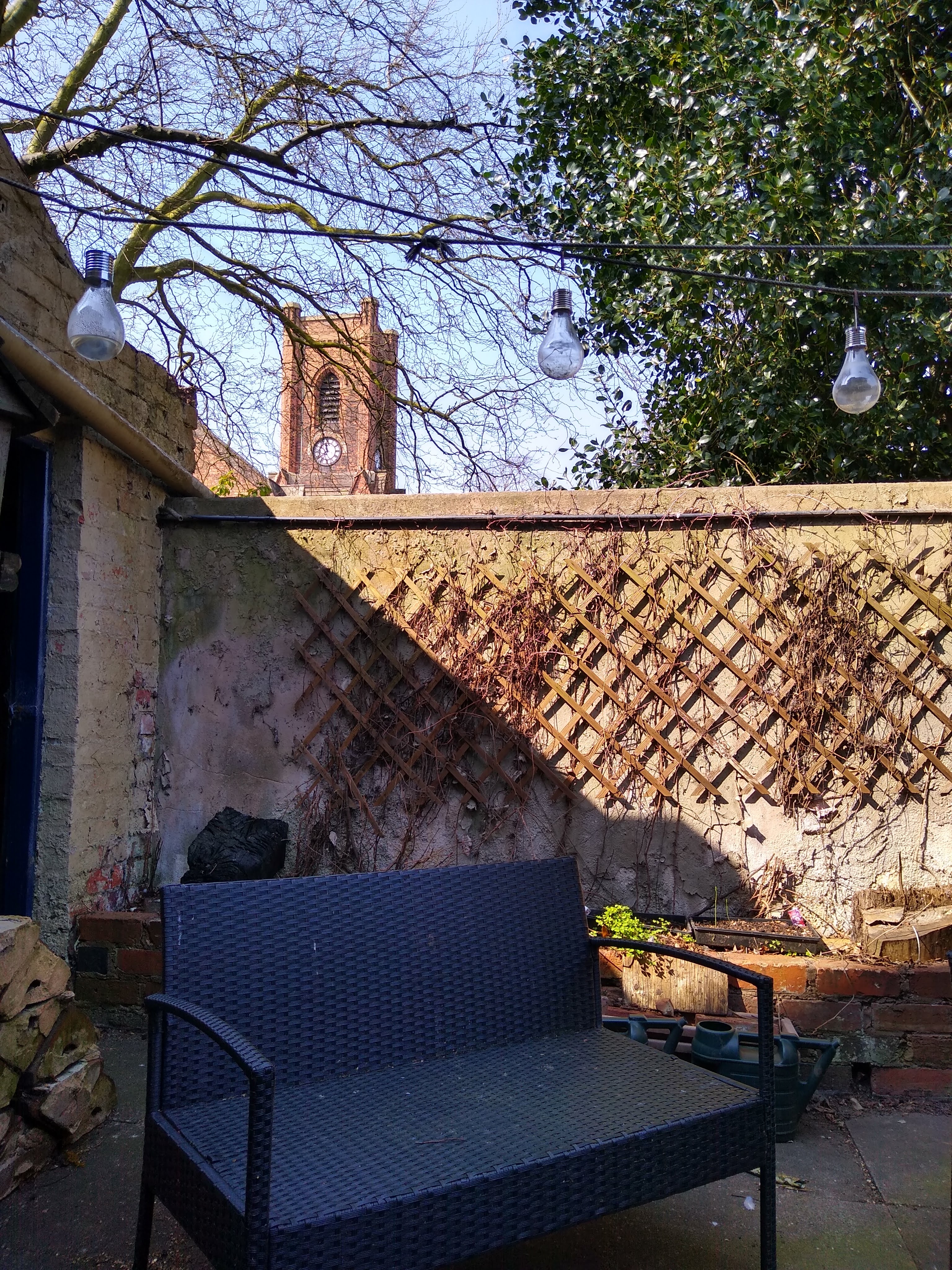
And so we wait tonight for the resurrection dawn. Not in a small room with the doors locked. We are waiting here, in the Vicarage. We’re waiting in the living room and the kitchen and in the garden, looking over to the church and its clock, running late and still on Greenwich Mean Time. We wait. But we know it is coming. Jesus has risen, as he said.








![[Text on grey/orange sunrise] Maybe huddling together as a small group of disciples in a home, wondering what God is doing, and what will happen next, and where do we go from here... is the most Easter-y of all Easter things to do - Gretchen Ronnevik](https://thevicarswife.blog/wp-content/uploads/2020/04/maybe-easter.jpeg)


 The Vicar's Wife