Feeds:
Posts
Comments

Posts Tagged ‘#lentowrimo’

Tonight in the Vicarage we had a favourite tea. Even the Engineer, the fussiest eater in the family, showed some definite enthusiasm when he saw what we were eating. It’s a great way to stretch a small pack of sausages out for several people, and is so simple it’s almost not a proper recipe. But here you are anyway. It might be a way to spin out some stuff you have in the cupboard. I’m no Jack Monroe (loving her #JackMonroesLockdownLarder on Twitter just now, where she makes recipes from people’s random pantry ingredients), but this is in the same spirit – made with everyday ingredients that you might just have in.

Ingredients

  • An onion, chopped
  • Garlic cloves – two or more as you like – also chopped
  • 1/2 tspn chilli flakes
  • 1 heaped tspn fennel seeds (these are great, but I know you might not have them in, so don’t worry if you don’t)
  •  Pack of sausages (there were six of them this evening to feed four of us) – each sausage cut into three or four pieces
  • Tin of tomatoes
  • Tomato puree (if you have it – I didn’t this evening)
  • Tin of beans – I used white kidney beans (cannellini), but borlotti, flageolet or red kidney beans would be fine, and if you don’t have beans you don’t have to use them

This is pretty straightforward – put a little oil in a pan and add the onion and garlic then the chilli and fennel and cook gently for a few minutes until the onion is translucent and the garlic golden. Then add the chopped sausages, like mini meatballs. I often use sausages from the freezer for this recipe and have found that they are much easier to cut into chunks if they are not entirely defrosted. Brown the sausages and then add the tin of tomatoes, a couple of tablespoons of tomato puree and the tin of beans, including the liquid in the tin. Add another half tin of water, together with salt and pepper, and bring the sauce to the boil. Then cover the pan and simmer for about half an hour.

We usually have this with penne pasta – it’s a pretty chunky sauce, and serve with a good grating of parmesan or other strong cheese. The chilli and fennel give an extra zing to the flavour. You could stretch it to six people if you added an extra tin of tomatoes or beans. Happy eating from your cupboards and freezers!

Read Full Post »

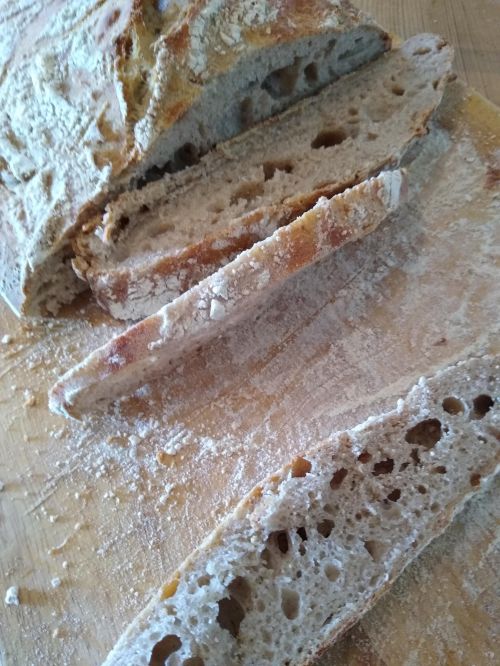
Encouraged by a friend who was asking about sourdough a week or so ago, I posted my recipe and resurrected my starter. It had been sitting in the kitchen for many many months and had turned to a sort of strange buttery substance with a black liquid on top. I probably should have thrown it away but I kept on meaning to restart it.

I actually managed to inspire myself as I reminded myself of the joy of sourdough baking – it’s honestly like a sort of magic – making just flour, water and salt raise itself into a loaf. I used a spoonful of the ancient buttery starter, and threw the rest away, and followed the starter recipe. And today we had sourdough for lunch in the Vicarage – a sharp nutty loaf to go with some simple cheese. The starter has a bit of a way to go to make a perfectly textured loaf, and I need to get back in the sourdough groove, but it was still delicious.

When I restarted this blog, I wrote about our parish smelling of bread and spices. Sometimes the scent of bread and spices is right here in our Vicarage, not in the streets outside, but we hang onto the hope of the gospel – the bread of life, the aroma of grace. In these uncertain days, bread and spices will keep us pointed to the only way of hope.

IMG_20200325_132115161


Read Full Post »

We’re settling into a new normal here in the Vicarage, as I expect many of you are. And in the second day of homeschool a certain amount of disillusionment has set in. Turns out that learning Tudor church history from a textbook is not that easy. But then we discovered that if you read it to yourself out loud and record it, you can actually concentrate on Henry VIII’s vacillations about communion without being distracted by squirrels.

The day finished with our small group meeting over Zoom. Although a couple of members couldn’t join us – it’s going to take a while to get everyone up to speed with the technology. But we also had the blessing of a group member who can’t usually attend because he lives too far away. I think that many churches will be doing many things – including groups – differently when this is all over.

What I won’t be doing differently in the future is my hair. I like my haircut. But for now it is certainly going to be different. I called my hairdresser to make an appointment a couple of weeks ago because it was getting a bit long, but she was off with a bad back. So I was wondering what to do about my fringe and had been thinking about finding someone else to do it. And now I can’t do anything! Except ask the Vicar or one of the boys to cut it *nervous face*. I have thick hair in a shortish bob and a heavy fringe so when it grows I start to resemble Hamish the Highland Cow, a firm favourite with our kids when they were young. I don’t keep toffees in there though. Yet.

Hamish

Read Full Post »

So when I restarted this blog back on 26th February, just 26 days ago, no-one would have imagined that by time Lent was hardly half done we’d all be locked down, that church would be shut, that weddings and baptisms would be forbidden, that the Vicar would be recording Bible reflections and Morning Prayer to YouTube and Facebook and that all our meetings would be happening on an app I had barely heard of until a few months ago.

And I also didn’t realise that my reflections on coping with a messy head would actually become tips for coping with the weirdness of a global pandemic. I had a messy head about other life things, but now Covid19 has come along to mess with all our heads. So much is not normal. So much is strange. The boys are home schooling. The Queen is sat in her student flat with the campus almost empty. Our days are revolving around video uploads and contacting parishioners online and over the phone.

The Vicar’s reflection tonight was about lament, and there is so much to lament at the moment: the removal of the normal, the deaths that have come and will come, the battles faced by medical staff, the struggles of businesses, the increase in domestic violence, the anxiety and the disruption. And we are lamenting and will continue to do so as this virus causes pain and trouble.

And yet we are people of hope here in the Vicarage and in this parish. God’s people under siege in Jerusalem so many years ago could say that the steadfast love of the Lord never ceases. And we can say it too. We are waiting here too. Waiting quietly for the salvation of the Lord.

[Text in green circle over photo of hawthorn blossom] The steadfast love of the Lord never ceases; his mercies never come to an end; they are new every morning; great is your faithfulness. “The Lord is my portion,” says my soul, “therefore I will hope in him.” The Lord is good to those who wait for him, to the soul who seeks him. It is good that one should wait quietly for the salvation of the Lord..

Read Full Post »

It’s been another mad busy day in the Vicarage, wrangling technology, reformatting flyers and delivering service sheets and information to parishioners. Our first online service is broadcast tomorrow. And tomorrow we’ll see if it works…

So here, to clear my head, and for some Saturday evening cheer, are some snaps from this week – life in the Vicarage and Spring in the Valley: daffodils and hawthorn in bloom, the Vicarage Aslan guarding our front door, a lunch made and arranged artistically on a plate by the Joker, a bunch of Mothering Sunday flowers sent by the Queen, the Vicarage Hound gazing longingly at a crisp in my hand.

There is still beauty and joy around, even when things are busy and messy and scary. Looking at beauty and joy captured on camera – and even arranging the photos in a pleasing layout – helps my messy head to remember it. And that helps me to remember that the Lord, the Lord who created beauty and joy, reigns.

Read Full Post »

So today was the day of the Vicarage getting up to speed with tech. The Vicar and I are  already fairly comfortable with technology – we both blog and tweet and have Facebook accounts. We’ve uploaded videos online before and we can populate a website. Perhaps the advantage of our backgrounds in engineering – we’re not scared by machinery.

Because now church is going mostly online – there will be no Sunday services or midweek meetings for the foreseeable future. And so we’ve had a big day of pretty fast learning. We had to get a church YouTube account, we’ve been drafting blog pages and we’ve been getting our heads round Zoom and finding out about Facebook Live.

The plan is also to record and broadcast a daily prayer service at the times we’d usually host our Open Church. So people will be able to connect when they might normally come in for tea and toast. And we’re going to broadcast a morning service live on Sundays. And we’re hoping to run youth Bible studies and prayer meetings and maybe even some toddler and kids work over the internet too.

We’ve also found a telephone service which is accessed through dialling in, so people who don’t have the internet will be able to listen to a short message or a sermon over the phone. And we’re going to deliver leaflets with details around the parish and service sheets to those we think would like to join in with the services. And of course we’re making lists and aiming to phone people up and contact them individually throughout the week too.

Phew.

And I’ve been having to remind myself that this Sunday is just the start of an extended time of doing things differently. So we can adjust and improve as time goes on, but hopefully start in some sort of helpful way.

The old joke made to vicars is that they only work one day a week. And now of course the joke will be that they don’t have anything to do at all. But actually what is happening is that the week long work is changing and there are steep learning curves being climbed by gospel ministers here in the UK and all over the world as they develop ways of pastoring through this pandemic. Pray for us – for videographic mercies, for photocopying grace and for our bandwidths on Sunday morning.


exponential learning

Graph of time vs clergy competence in tech since last week


Read Full Post »

There is something enormously stress busting about working with your hands. Craftsmen and women have always known this. But some of us have been a bit late to the party. I’ve been told by a trauma specialist that repetitive movement is very good for a messed up head – so running – making repetitive movements with your legs, and crochet and knitting, where the movement is in your hands, are all good when you’re feeling stressed, whether from ongoing trauma – or from a current difficult situation.

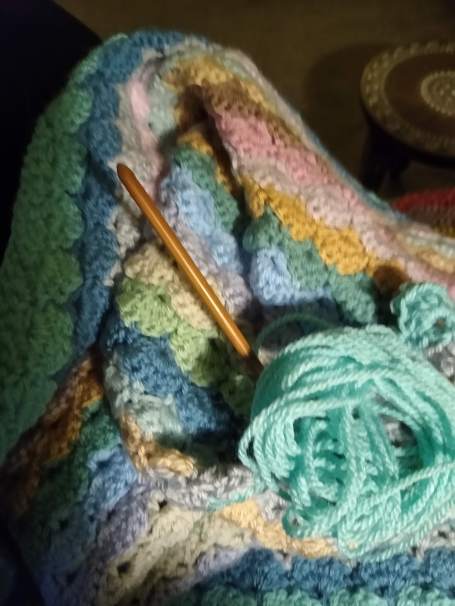
And I can confirm that this is absolutely true. I decided in September that I would crochet a blanket. I’d admired ripple blankets I’d seen in glimpses of people’s living rooms online for some time, and I found out about the definitive tutorial website for crochet blankets. And Dreamer, who is already an experienced crocheter, mentioned that she had thought about making a blanket, so I knew I’d have company (or maybe competition). I was a complete crochet novice, so I practised by making half a scarf. And then I ordered the kit from Attic 24: a woodland blanket (although I used the slightly simpler neat ripple pattern). And it couldn’t have been better – glorious colours to match my living room – and hours of distraction for my restless fingers and buzzing head.

And when one wave of stress finished, so did my blanket. And it fits the chair perfectly.

Woodland ripple blanket

I lasted about a fortnight before buying the kit for another one – this time one perfectly designed for the Queen – whose favourite colours are muted blues and pinks and whose college at university is called Fylde (you’ll see the link if you read the description). And this one is going to be my quarantine blanket I guess.

Dune blanket progress

On last night’s Midlands Today they had the veteran presenter Nick Owens reporting from his self isolation and talking about what he’d been up to. He described a visit to a wool shop, where yarn was flying off the shelves. Perhaps not as fast as loo roll, but he said that there were a lot of purchases. Obviously by sensible people who realise that you can have a productive, creative and beautiful way to deal with stress. So whether your head is messy from something else, or it’s getting messy because of the constant news agenda, why not join me in fiddling with yarn instead of a phone?

Read Full Post »

So yesterday the Church of England announced the suspension of all public worship. So things are going to look very different here for a bit. And then today we learnt that schools are closing, so homeschool is looming. And the Queen is up at university, making lockdown lists.

Our Open Church has been running this week, allowing people to see one another and connect briefly, as well as pray and seek help if they need it. And we’re thinking through how to keep everyone connected online. We’re not a very techie community – many people don’t have broadband at home, and some don’t even have a mobile phone, not even a text and dial one. So we are going to try and get creative, maybe delivering paper service sheets and looking into a dial a sermon/podcast service, as well as looking at other stuff that many churches are doing – Facebook Live and YouTube services and general online things.

But although we’re going to be doing things differently, we serve a God who never changes. Tonight, in a fit of Anglicanism, the Vicar and I prayed Evening Prayer from the 1662 BCP together. The set Psalm for this evening was Psalm 93 – The Lord Reigns – a truth to hold onto when everything else is different.

[Yellow text on background of grey slate roofing tiles] Psalm 93 The Lord reigns; he is robed in majesty; the Lord is robed; he has put on strength as his belt. Yes, the world is established; it shall never be moved. Your throne is established from of old; you are from everlasting. The floods have lifted up, O Lord, the floods have lifted up their voice; the floods lift up their roaring. Mightier than the thunders of many waters, mightier than the waves of the sea, the Lord on high is mighty! Your decrees are very trustworthy; holiness befits your house, O Lord, for evermore.

Read Full Post »

Ages ago, when I was slightly more on top of life, I went through a phase of baking sourdough. I love the taste of the bread, and it keeps brilliantly. And if we’re all going to stuck at home for a bit, I think the relaxing rhythm of the baking would be good for us all. And a friend has just asked online for sourdough recipes, and I discovered most of this post lurking in my vast drafts folder.

There are loads of sourdough recipes online. So when I first had a go, I cobbled one together from the internet and a packet of bread flour, because I’d not yet bought a book. It works just fine. It looks long, but it’s actually pretty simple: make the starter over the course of a week, knead over a morning, an afternoon or an evening, prove overnight, bake in about half an hour.

I made my sourdough starter from the recipe on the flour packet, which was as follows:

Day 1: 75g flour, 75ml water. Stir to thick paste. Leave in jar with about 1l capacity in a warm place. The Vicarage kitchen was fine, so it doesn’t have to be super warm.

Day 2: Add the same again.

Day 3: And again. The mix was starting to bubble a bit and smell a bit yoghurty.

Day 4: And again. By now I’d realised that 75g flour is about 125ml, so I started using a heaped 1/2cup measure for the flour. This isn’t baking, so an exact measurement isn’t that important.

Day 5: And again.

Day 6: And again.

Day 7: And again. This is then enough to start making the sourdough. The starter was bubbling nicely by now and smelling full of lactobacillus. It tastes quite sour. Unsurprisingly.

So then I started with the bread itself. And all you need to add to the starter is flour, warmish water and salt. My recipe is a slow kneading one, which can be done over a few hours, but is pretty flexible if you’re in and out of the house. It can also be done in an evening though if you’re out all day. There are heaps of other techniques all over the internet. Basically, you’ve got some yeast in the starter, so you can make bread with it somehow. The yeast works better if worked slowly but I’ve made pizzas using a dough that’s only had a few kneads over an hour or two.

Ingredients

  • 200ml sourdough starter (original recipe said 150-250g but you need to scoop it out anyway and this is over 150g)
  • 500g bread flour (any sort)
  • 1 tspn salt
  • Around 350ml water (for the example loaf pictured here I used about 1/3 strong brown flour to 2/3 strong white and about 400ml water – the starter was quite stiff)

The key thing about sourdough is that you make quite a wet dough compared to the dough you’d make using instant yeast. I started first with strong white flour and exactly 350ml water. Trying it this way gives you a feel for the sogginess of the dough, but I don’t bother measuring now. You need more water if you’re using brown flour, or a mix. The recipe is very flexible. If your dough is super wet you’ll get a flat loaf with quite an airy texture. A drier dough gives me a denser loaf which holds its shape better. All delicious though.

I mix my dough in a pyrex bowl, using a silicone spatula. Then I leave it, covered with a cloth for ten minutes. No kneading. And then I do a series of kneadings and leavings as follows:

Mix dough, leave 10 minutes, in your bowl, covered with a clean teatowel or a muslin cloth, if you have some lurking.

Knead by folding over about 15-20 times. It will be sticky, so oil your kneading surface, and the inside of the bowl before placing it back, then leave it for another 10 minutes, covered. I have a plastic scraper that I use to gather everything back together and avoid lots of dough getting left on my board.

Knead 15-20 times on oiled board, leave 10 minutes in oiled bowl, covered. You really need the oil.

Then repeat again 4 times, leaving your dough for:

30 minutes

1 hour

1 hour again

1-2 hours NB All these times are pretty flexible, and you can probably get away with missing one or two of the kneads out.

Finally knead 15-20 times and leave the dough to rest on your board, covered with the cloth. Whilst that is happening, wash and dry your bowl. When your ten minutes are up, take your cloth, cover it liberally in bread flour and place it in the bowl, where it will serve to shape your bread in its final prove. Then fold the dough into a vague round shape, using lots of flour and pop it in the bowl (which should be about the same size as the dough, with a bit of room for rising), scatter over some more flour and then pop another cloth or some other cover on (I have a silicone cover that is super useful for this sort of thing).

If you don’t use enough flour, it will stick to the cloth, which can be quite a stressful experience as you try to extract it onto a very hot baking sheet. So ladle on the flour. This is how I did it for my first few loaves. Then I had a birthday and a banneton for a present (a 1kg banneton is perfect for this recipe) which is a bit easier – you just flour the banneton and top it with a cloth. The cloth and bowl combo worked fine though. My bowl has a capacity of about 2l.

Then pop your bowl or banneton in the fridge and leave it overnight, or a couple of nights. It will rise very beautifully.

Then, when you are wanting to make your bread, pop a baking sheet in the oven and whack the temperature up to the highest it will go. This is about 250C on my oven (I think – it’s past 240C anyhow). Also place handy a sharp carving knife or similar, a small deep baking tray eg a cake tin, with a glassful of water in it and some polenta or more bread flour. Retrieve your now risen loaf from the fridge.

Once the oven is hot, take the baking sheet out and put it on a slip proof, heat proof surface (I use the top of the cooker). Sprinkle the tray with polenta or flour and then invert your bowl or banneton on the sheet. It will start to spread out. Cut a deep cross in it, about half way through the dough. Then pop it in the oven, followed by your water filled tin on a shelf below.

Cook for 15 minutes at your top temperature and then turn the oven down to 200C for 20 minutes. And then take out of the oven, cool and eat warm with butter. If there’s any left it is delicious in any way and especially makes the world’s best toast.

I have to go now and resurrect my starter. See you back here in a week with a loaf?
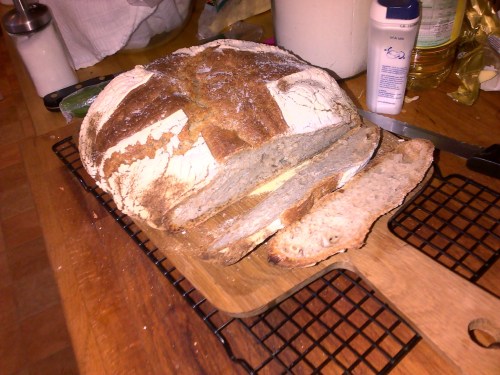
IMG-20130917-00180 (1)

One I made a *lot* earlier than this blogpost

Read Full Post »

It’s really not normal, is it? Such strange times we are living through now. We had a PCC meeting tonight and were discussing some issues with our services, and timings for the APCM (the annual meeting), as I checked in on Facebook to see what Matt Hancock had said in the House of Commons about whether churches should continue to meet. My FB feed told me that they shouldn’t, but the Church of England guidance isn’t out yet. So we are in limbo. This level of uncertainty is something pretty unsettling to be living with. And making any plans feels a bit pointless. But we have to keep on looking ahead, even if things are cancelled in the morning.

So I’m going to leave my worries with Jesus and try and get to sleep before midnight. PCC was enough trouble for today. Jesus said so.

Therefore do not be anxious about tomorrow, for tomorrow will be anxious for itself. Sufficient for the day is its own trouble. Matthew 6:34/picture of church and Victorian terraces across metro line, blue sky with clouds behind

A view of our church from the other side of the metro line

Read Full Post »

« Newer Posts - Older Posts »